
When the garden overflows with tender green peas, it’s time to capture that fleeting freshness for the months ahead. Pressure canning is a reliable method to preserve the sweet flavor of summer peas, ensuring they remain a delightful addition to your meals long after harvest.
Whether you’re a seasoned canner or a curious beginner, this guide will walk you through the process, making it approachable and rewarding.

If you look up the word “contentment” in the dictionary, you would find me right there, big as Dallas, on the porch with a basket of peas to shell.
That probably sounds silly to some of you, but that is so my happy place!
Well, that and my kitchen…
Sweet peas are another of those things that we love to eat fresh from the garden.
We eat them raw in salads, dip the young pods in veggie dip, and enjoy creamed peas at least once every year.
It’s also another one of those things that I plant way more than we can eat at once so that I have plenty to can for later to add to my food storage.
You can check out why I think food storage is so important here.
So, let’s walk through the process of pressure canning peas. Grab an apron and let’s get started!
THIS RECIPE MUST BE PROCESSED IN A PRESSURE CANNER
Not a pressure cooker, a pressure canner. Two different pieces of equipment.
YIELD: You can get approximately 2 pints or 1 quart of canned sweet peas out of 3 to 6 pounds of fresh peas in the pods depending on the variety and maturity of the peas.
A bushel of fresh peas in the pods weights 30 pounds which turns out to be about 5 to 10 quarts or 10 to 20 pints after processing.
How to Can Green Peas
Equipment
- Pressure canner
- Canning jars with no nicks or cracks
- New lids with rings/screw bands, either single use or Tattler reusable lids
- Lid lifter
- Bubble popper or thin knife
- Jar lifter
- Old towels
Check out my Ultimate Guide to Home Canning Essentials for links to all the stuff.
Ingredients
- Peas – 12 to 24 pounds will give you a canner load of 8 pints
- Sea salt ~ this is optional, if you choose to use salt don’t use regular table salt. Use sea salt or canning salt instead.
- Boiling water
Peas can be canned in 1/2 pint, pint, 1 1/2 pint, or quart jars. It all depends on how many people you are feeding at a time. Half pints are great for 2 to 3 people, and pints will stretch for 6.
Instructions
Prepping the Jars and Lids
The first thing you need to do is is get your jars prepped. Wash them in hot soapy water and keep them warm.
You can also run them through a quick rinse in the dishwasher and use the heated dry cycle like I do.
That keeps my jars hot for 45-60 minutes. Which is usually plenty of time for whatever I’m canning.
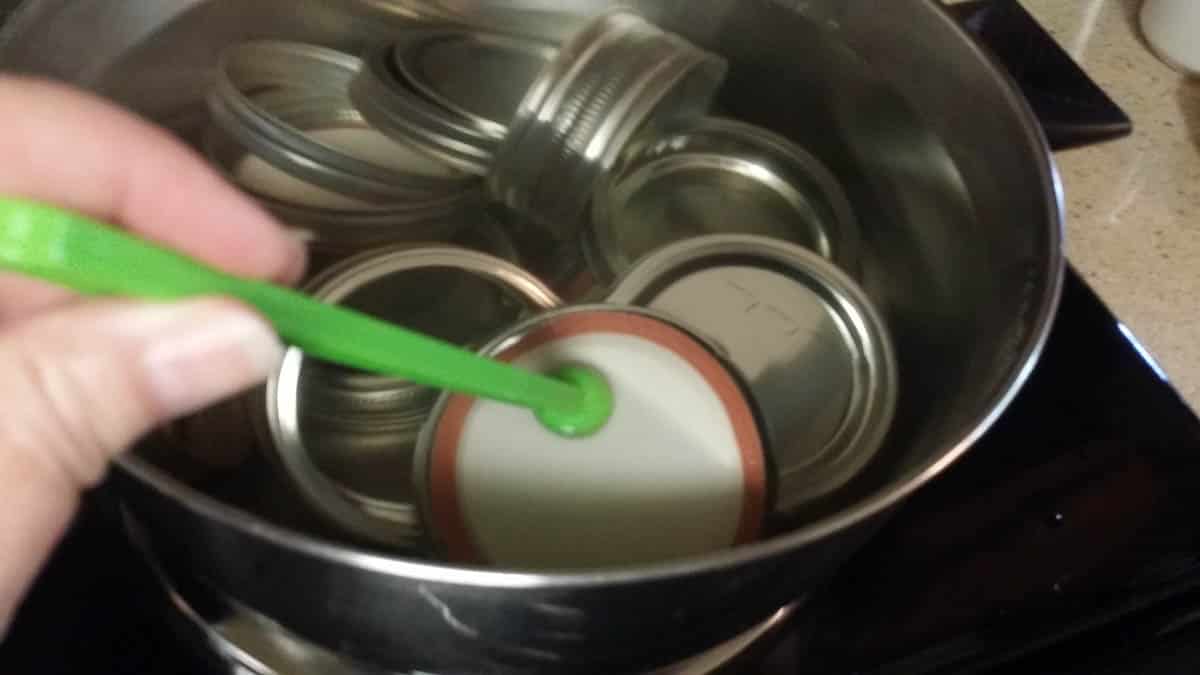
Next step is to get your lids and rings ready. For the single use lids this means I put both the flat lids and the rings into a pot and cover them with water.
Bring the water to a boil and then turn it down to a simmer. That softens the sealing compound on the lids so they can form a good seal.
For the Tattler reusable lids, follow the directions that came with them.
Prepping the Peas for Canning
Simply shell the peas and rinse in cold water.
Methods for Canning Peas
There are 2 methods that you can use for canning peas. Cold pack (or raw pack) and hot pack. I walk you through both methods below.
The only difference is blanching (or heating) the peas before you put them in the jars.
During processing, most things shrink up a little as they cook and release water. Blanching allows them to shrink before you pack the jars, so you can get a little bit more of whatever you’re canning into each jar.
There are some things that I always use the hot pack for, and some that don’t make that much difference. It all depends on how much water is actually in something.
For peas, I personally use the cold pack method because it’s just a little faster. But they will both work perfectly.
Cold Pack/Raw Pack Method for Canning Peas
When the peas are prepped, bring a large kettle or pot of water to a boil.
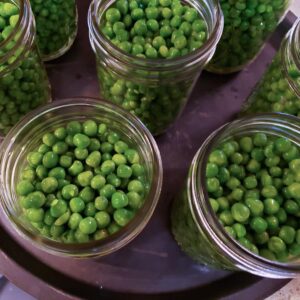
While that is heating, get your hot jars and begin to fill them. Pack the peas loosely into the jars.
Make sure that you leave a 1-inch head space between the top of the peas and the rim of the jar.
Go ahead and add your sea salt to the jars now. If you are using 1/2 pint jars add 1/4 teaspoon. Add 1/2 teaspoon to pints, 3/4 teaspoon to 1 1/2 pints, and 1 teaspoon to quarts.
After you’ve added the salt you need to fill the jars with that water that’s been boiling. Make sure you leave that same 1 inch of headspace.
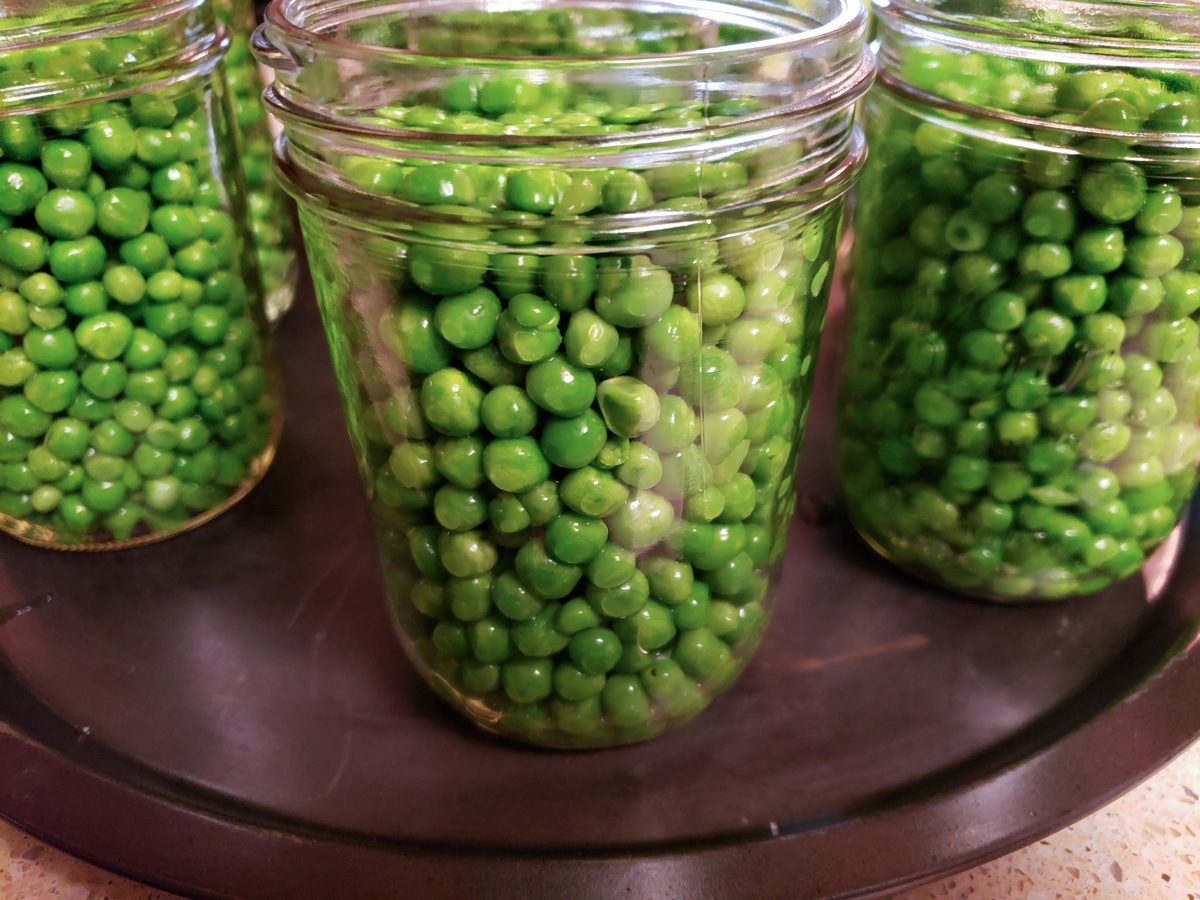
Now use your bubble popper or a thin knife to run around the inside of the jar to remove any air bubbles. Then top off the jars with water if you need to.
Then wipe off the rim of the jar and attach the lid.
Go through that same process with all of the jars and put them into the canner. Then jump down to the processing section.
Hot Process Method for Canning Peas
Follow the previous directions for prepping jars, lids, and peas.
Place the shelled peas in a strainer basket, a large sieve, or tie them into a piece of cheesecloth. (Or you could just toss them in the pot and use some tongs to fish them out, but the other way is easier.)
Blanch the peas by submerging them in a large pot of boiling water for 3 minutes. Remove the peas and let them drain for a minute.
Next, pack your jars loosely with the peas. Make sure you leave a 1 inch headspace.
Add the salt to each of your jars. Add 1/4 teaspoon to half pints, 1/2 teaspoon to pints, 3/4 teaspoon to 1 1/2 pints, and 1 teaspoon to quarts.
Grab a ladle and cover the peas with the boiling water that you blanched them in. Don’t forget the 1-inch headspace.
Now remove the air bubbles, and top off the jars with water if you need to. Wipe the rims of the jars, and attach the lids.
From here, continue with the directions below.
Processing Peas
Add the proper amount of hot water to your canner. It’s usually 2 to 3 inches, but check the directions that came with your particular canner.
Put the jars in the canner. If you have a tall enough canner and an extra rack, you can double stack the jars. I always try to stagger the layer on top so they aren’t directly over the ones on the bottom.
Then close and seal the lid.
Turn the heat to high and allow the steam to vent for the specified amount of time. Again, that time is going to depend on the canner and the pressure you need to achieve.
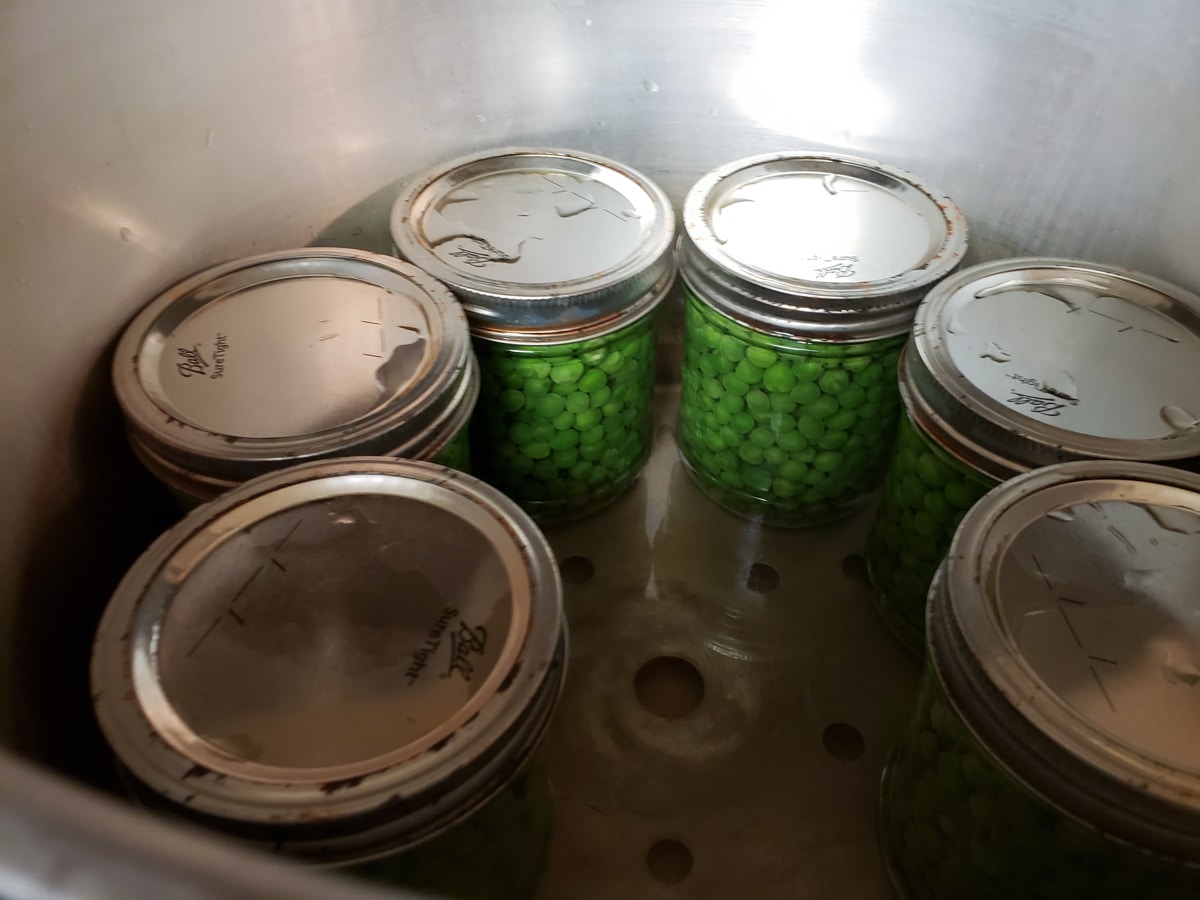
Once the steam has vented, add the weight. If you are using a dial gauge canner, just watch the dial. Once it’s almost up to pressure turn the burner down slightly.
If you are using a weighted gauge canner, you will know it’s up to pressure when the weight begins to jiggle consistently. Adjust your burner to keep it rocking slightly.
Bring the canner up to pressure, and start your timer.
Process Time at 10 pounds of pressure: Pints, 1/2 pints, 1 1/2 pints, and quarts all need to process for 40 minutes.
Don’t forget to adjust the pressure for your altitude. Use this altitude adjustment chart.
After processing for the required length of time, remove the canner from the heat so it can cool down. Follow the directions that came with your canner.
Never run cold water over your pressure canner! The sudden drop in pressure will cause the jars to explode!
Sorry to shout, but I’ve seen crazy things on the internet lately…remember, pressure canner, not pressure cooker!
Once the pressure has dropped to zero, carefully open the canner with the lid facing away from you. Otherwise you’ll get a face full of steam. And that’s no fun!
Use the jar lifter to carefully remove the jars straight up out of the canner. Don’t tilt the jars because they may not be sealed yet and you don’t want anything to leak out.
You need to put the jars on a double layer of towels somewhere that isn’t directly in a cold draft. If it’s drafty, throw another towel over the top to protect the jars.
Make sure the jars are somewhere that isn’t going to be in your way. Cuz now they need to sit undisturbed for 12 to 24 hours. If you do your canning in the evening, you can let them sit over night so that’s not really a problem.

Checking the Seals
After at least 12 hours you can check the seals. If any of the jars didn’t seal you can reprocess them with new lids. Check the rim of the jar to make sure there aren’t any nicks that made the seal fail.
If you don’t want to reprocess, no worries. Just stick it in the fridge and eat the contents within a week or so.
Storing your Canned Peas
The last step is to remove the rings and wash them and wipe down the jars. Make sure you label and date the jars and add a batch number if you do more than 1 canner load. You can use stick on labels, or you use a sharpie to write on the lid.
For the best results, store your canned peas in a cool dark place. They can be stored for up to 2 – 5 years, depending on conditions, before they begin to deteriorate.
Never use home canned food from storage that has a broken seal! When in doubt, throw it out!
Using your Home Canned Peas
To use these peas as a side dish, simply pour a jar of peas with the liquid into a saucepan and heat.
You can toss them into a Shepherd’s Pie, or a tuna noodle casserole.
You can chill them and add them to salads.
You can also add them to soups or stews.
However you serve them, it’s all good!
And there you go! With a few simple steps, you’ve transformed fresh peas into pantry staples that bring a taste of summer to your table year-round.
There’s something deeply satisfying about preserving the harvest—it’s a nod to tradition and a gift to future meals.
If you have any questions or would like to share your canning experiences, I’d love to hear from you in the comments below. Happy canning!
Blessings!
Always check with the National Center for Home Food Preservation for up to date canning guidelines.

Frequently Asked Questions About Pressure Canning Peas
Properly sealed and stored canned goods will last decades. Most people suggest eating within 2 years for the best nutrition.
No. Peas are not acidic enough to safely can in a waterbath canner.
You do not. And I typically don’t because it takes more time to blanch them first.
More canning recipes you should try:


Canning Peas
Equipment
- Pressure Canner
- Jars and rings
- New lids
- Canning Tools
Ingredients
- fresh peas ~ about 12 to 24 pounds of fresh peas in pods gives you a canner load of 8 pints
- filtered water
- sea salt optional
Instructions
Getting Prepped
- Prepare your jars. Make sure they are clean and keep them hot until needed. Prepare your lids following the manufacturer’s instructions.
- Shell the peas and rinse with cold water.
Cold (or Raw) Pack Method
- In the cold pack (or raw pack) method, pack the peas into one hot jar at a time leaving a 1-inch headspace.
- Fill the jar with boiling water, leaving 1-inch headspace. Remove the air bubbles and top off if necessary.
- Wipe the rims with a clean, damp cloth, and seat the lids.
- Put on the rings, tightening them to finger tight.
Hot Pack Method
- In the hot pack method, blanch the peas in boiling water for 3 minutes, then pack them into the hot jars, leaving 1-inch headspace.
- Fill the jars with the boiling blanching water. Remove bubbles and top off if necessary.
- Wipe the rim of the jar, seat the lids, and put the rings on finger tight.
In a Pressure Canner
- Add the amount of water to your canner that your directions tell you to.
- Put the jars in the canner, then put on the lid and lock it.
- Exhaust the air for the length of time specified in your instruction manual.
- Add the weight and process at 10 pounds of pressure for 40 minutes for half pints, pints, 1-1/2 pints, and quarts.
- Make sure you adjust pressure according to your altitude.
- After processing time, remove the canner from the heat and allow to cool on it's own. When the pressure has dropped to zero, carefully remove the lid.
After Processing
- After processing, remove the jars from the canner lifting the jars straight up. Put the jars on a towel covered cabinet out of drafts, and leave undisturbed for a minimum of 12 hours.
- After 12 hours, check the seals. If the seals are good, remove the rings, wash the jars, and label and date them.
- If the jars are not sealed, you can reprocess them with new lids or simply refrigerate and use within 2 weeks.